Q'eros - Ancestral Spirituality in the Last Inca Community
Meta Description | Q'eros is a community that keeps alive the spirituality of the Peruvian Andes. Learn more about ceremonies, way of life of the last Inca settlement.
The Q'eros community is located in the highlands of Paucartambo, in Cusco. This community maintains to this day a worldview based on harmony with nature. Their ancestral spirituality holds invaluable cultural value, as it comes directly from Inca traditions. Discover here their history, their culture and, above all, the spiritual legacy of the last Inca community.
The Q'eros, the last Inca community (history)
The Q'eros community is one of the last Inca settlements that still preserves the connection between human beings and the ancestral Andean worldview. In this place, you can find a close relationship between the spiritual world, nature, and human beings.
Since the arrival of the Spanish, the Q'eros community was able to preserve each of their traditions. Especially those linked to spirituality. This was vital for them to survive for more than 500 years.
Throughout many years, they managed to survive without contact with the civilization developing in Cusco and Peru. Records indicate that the first contact with the Q'eros occurred in 1950.
The Q'eros community managed to remain apart from civilization because it is located in the highlands of Paucartambo. The community consists of dwellings built in mountains at more than 5,000 meters of altitude.
The main activities this community performed to subsist were agriculture, herding of llamas and other camelids. Likewise, they continued performing activities related to spirituality, natural medicine, and they also guard great treasures such as songs and dances.
Since 2007, the Q'eros community has been considered a Cultural Heritage of Peru. This is thanks to the knowledge they still maintain, the cultural expression they transmit, and especially for their work in connecting with the spiritual and the preservation or respect for nature.
The Q'eros community, also known as the Q'ero Nation, is actually a set of several populations. Among these, the presence of 5 communities stands out: Marcachea, Quico, Q'ero Totorani, Japu, and Hatun Q'eros. Also worth mentioning are Kaliakanta, Ccachupata, and Pucara. All these communities belonged to the Antisuyo during Inca rule.
Ancestral spirituality in Q'eros
The Q'eros are direct and original descendants of the Incas. That is, they are one of the Inca ayllus that was part of the Antisuyo. The communities that are part of the Q'eros nation were able to maintain their lifestyle and customs for more than 500 years.
Being a population linked to Pachamama and nature, it is not surprising the meaning of their name. The name Q'eros could come from the Quechua word "Q'iru" which means "wood".
The worldview and most activities they perform are closely linked to the close relationship between man and nature. This harmony is essential for the Andean man who holds special respect for all beings with whom he coexists.
The spirituality that is maintained has been passed down from generation to generation. According to them and ancestral tradition, human beings have the potential to evolve their consciousness. Likewise, they can enhance not only spiritual abilities but also physical and emotional ones.
The Q'eros have maintained a close relationship with the cosmos and the vital energy that can be found throughout the planet. Hence the respect for nature arises. Likewise, the harmonious relationship with nature allows human beings to reach a divine potential.
How to understand the ancestral spirituality of the Q'eros?
Let's learn some concepts to better understand the spirituality that has been maintained until today. Thanks to the Q'eros, it has been possible to better understand some religious perspectives and ancestral rituals of the ancient inhabitants of the Andes.
The paqos
From ancestral tradition, the person in charge of performing thanksgiving ceremonies, purification, and others was the paqo. This is a character linked to spirituality, who can be considered a shaman or priest.
The main function of the paqos is to grow their own spirituality. The purpose of this is to evolve on the astral plane.
Thanks to the spirituality acquired over a long time, the paqos possess the knowledge and wisdom of the energies that can guide people and their own ayllu.
For the inhabitants of Q'eros, in general, human beings are living energy. It is this energy that closely links them to the cosmos and the universe. Therefore, it is important that the relationship between humans and the universe be harmonious and of mutual gratitude.
Sacred places
An essential aspect of Q'ero spirituality is the veneration of sacred places. Unlike other religions, these are not temples or majestic buildings, but natural spaces that offer life and energy.
The sacred and spiritual places for the Q'eros are mountains, rivers, some caves, lakes, lagoons, natural water sources, and even spaces that house great natural resources.
They are sacred places because they are sources of life and at the same time are spaces that allow connection with the very energy of the universe.
Harmony with nature
The Q'eros managed to maintain part of their population and cultural traditions for more than 500 years. They did so harmoniously and without disturbing the areas where they built their structures.
For ancestral Andean tradition, it is important to maintain harmony with the environment and, as much as possible, avoid making major changes that affect the free flow of the energy that composes it.
They also managed to maintain their agricultural lands, and herding activities are done in an orderly and controlled manner. Only in this way can one obtain what is necessary from nature and also give thanks for what it provides.
Currently, the Q'eros nation is working to ensure that this harmony is not broken. Since the main spiritual connection of living beings is with Pachamama.
Good living
The way the Q'eros see the world is completely different from the Western perspective. Therefore, one must stop for a moment to better analyze this perception.
For example, reciprocity stands out as a fundamental axis for building community. This being, at the same time, vital for the survival of the Q'eros nation.
At the same time, it is vital for the Andean inhabitant to give thanks to Pachamama for the opportunity of life it grants. Besides being the main source of food.
The connection with nature is strong; they managed to coexist and live with ancient Andean techniques and methods. One of them, medicine that only uses natural products such as herbs, seeds, roots, fruits, and more.
The person in charge of performing thanksgiving and petition ceremonies is the paqos. Sometimes, these ceremonies are also performed to ask for health or protection from the divine entities of the Andes.
Preservation of cultural heritage
The Q'eros nation is one of the best examples of cultural, natural preservation and techniques of agriculture and herding.
Currently, in Q'eros you can also find a great variety of corn grains, potato varieties, and other crops. On the other hand, they also guard knowledge of natural medicine.
All the knowledge they maintain today continues to be transmitted to younger generations orally.
Location of Q'eros, last Inca ayllu
The Q'eros nation is located in the highlands of Paucartambo. But also some of the communities that are part of the nation are located in cloud forest territory.
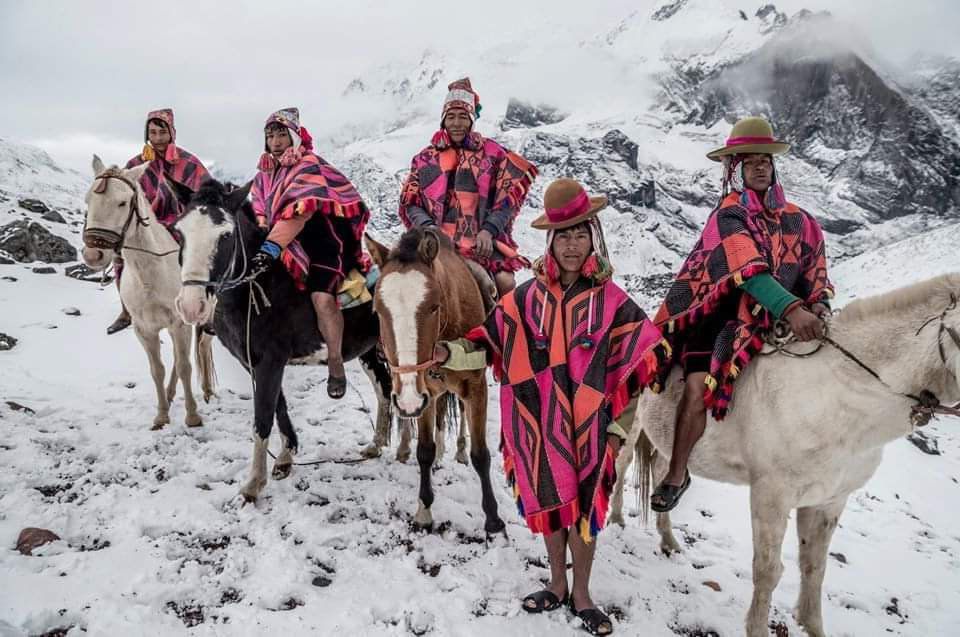
Likewise, the community located at the highest altitude is the one near the Ausangate snow-capped mountain.
The people of these communities exchange their agricultural productions and also other products such as wool, animal meat, and more.
As a way to protect the population and the territory they inhabit, the Peruvian State managed to create in 2021 the Cusco Regional Conservation Area "Q'eros – Kosñipata". All the protected territory is more than 55,000 hectares.
How to get to Q'eros?
Currently, only some of the communities offer the opportunity to receive visitors. Although increasingly, the inhabitants are encouraged to offer experiential tourism services.
For this reason, the trip can be made in two ways: the first is by purchasing tourist packages that offer experiential tourism. The second option is to make the trip on your own by taking the route from Cusco to Paucartambo and taking the detour towards Pilcopata.
An important piece of information to keep in mind is that to reach the communities, you have to walk for several hours. Something that is quite enriching and the ideal opportunity to start connecting with nature.
Living cultural practices in Q'eros
The Q'eros nation has managed to preserve important cultural practices:
- Herding: The inhabitants of the communities organize themselves for herding in various areas near the dwellings. Herding is vital for obtaining wool from camelids and also as a food source.
- Textile work: Once the wool is acquired, it is mostly women who are in charge of spinning the wool. Then, the wool is dyed with seeds, flowers, and other natural products. Likewise, garments and decorations are made.
- Natural medicine: The inhabitants have at hand a collection of various herbs, leaves, seeds, roots, and plants in general that serve as a source of healing or natural medicine.
- Celebrations: The communities organize themselves to celebrate their festivities such as carnivals, worship or payment to the earth, and more. These celebrations have in common that they are presided over by ceremonies. Among the celebrations, music and chants alluding to plants, food, and life situations also stand out.
- Legends: They still promote and share their legends. Among these legends, the figure of Inkarri appears. This legend has some variations, but it speaks of the spiritual elevation of human beings.
- Andean ceremonies and rituals: Like most Andean communities, all rituals and ceremonies are celebrated in the Quechua language. The presence of coca leaves and chicha de jora is also vital.
Can I visit the Q'eros Nation?
Yes, it is possible to visit the Q'eros Nation. To make the visit, the most recommended way is to do so with the presence of a tourism agency.
If you visit these places, request an Inca ceremony to thank Pachamama for making your visit possible.
Also remember that the visit will be done walking, and it will be important to be prepared for such activity. Also, try to bring only what is necessary.
What is experiential tourism like in Q'eros?
- Experiential tourism in Q'eros is perfect for connecting with nature and with the energy that the apus or protective deities have near this place.
- There are several options for experiential tourism. From just one day to two or three days.
- You can also take walks to visit all the communities that make up the Q'eros nation.
- That said, it is important to emphasize that the space and dwellings are rustic but quite welcoming.
- It is important to make the trip with a tourism guide or person who speaks Quechua. All inhabitants of Q'eros speak Quechua perfectly and very little Spanish.
- Remember to enjoy the experience and connect with nature. Also take advantage of the space to perform an Inca ceremony.
Frequently asked questions about the last Inca community of Q'eros
1. Who are the Q'eros and why are they considered the last Inca community?
The Q'eros are a Quechua community located in the highlands of Paucartambo, Cusco. They are considered the last Inca nation because they have preserved intact their traditions, language, spirituality, and way of life since pre-Hispanic times, without having been completely influenced by modernity.
2. What role does spirituality play in the daily life of the Q'eros?
Spirituality is the central axis of Q'ero life. It is based on the Andean worldview, which considers the universe as living energy. The connection with Pachamama, the Apus, and other natural elements guides their rituals, decisions, and community relations.
3. What are the paqos and what is their function within the community?
The paqos are Andean wise men, considered shamans or priests, in charge of performing ceremonies of gratitude, healing, and spiritual connection. Their role is fundamental to maintaining the balance between human beings, nature, and the cosmos.
4. Is it possible to visit the Q'ero Nation and participate in their rituals?
Yes, some Q'ero communities offer experiential tourism. Visitors can participate in walks, community living experiences, and ancestral ceremonies, always with respect and accompanied by guides who speak Quechua.
5. How have the Q'eros managed to preserve their culture for so many centuries?
Thanks to their geographical isolation, community organization, and oral transmission of knowledge, the Q'eros have kept their cultural practices alive, such as textile work, natural medicine, Andean rituals, and legends like that of Inkarri.
6. Where is the Q'ero Nation located and how can you get there?
The Q'ero Nation is located in the highlands of Paucartambo, Cusco, and some communities also extend into the cloud forest. To get there, you can take the Cusco–Paucartambo route and turn off towards Pilcopata. Final access requires walks of several hours, so it is recommended to be physically prepared.
7. What makes Q'ero spirituality unique?
Q'ero spirituality is based on the Andean worldview, which considers the universe as living energy. The connection with Pachamama, the Apus (mountain spirits), and other natural elements guides their rituals, healing practices, and thanksgiving ceremonies.
8. What cultural activities can be observed in Q'ero communities?
Among their living practices are herding of camelids, textile work with natural dyes, traditional medicine based on plants, ritual celebrations in Quechua, and oral transmission of legends such as that of Inkarri.
9. Is it possible to visit Q'ero communities as a tourist?
Yes, some communities offer experiential tourism. Visitors can participate in ancestral ceremonies, live with local families, and learn about their culture. It is recommended to do so with guides who speak Quechua and respect local customs.
10. What measures have been taken to protect Q'ero territory?
In 2021, the Peruvian State created the "Q'eros – Kosñipata" Regional Conservation Area, which protects more than 55,000 hectares of territory. This measure seeks to preserve both the ecosystem and the cultural and spiritual heritage of the Q'ero Nation.